Wednesday, November 3, 2010

The unconquerable land


Ayodhya a land which has grown to international importance, has its name come from the sanskrit root word yudh, meaning "fight" or "wage war" and it translates to either "not to be fought" or, less literally, "unconquerable." It may seem to anyone that it has grown to importance for its root origin (fight, wage war) rather than for its complete meaning (not to be fought). 

Most of us are aware of the history of events that took place at Ayodhya way back since 1992 when Babri masjid was demolished till the recent Allahabad HC verdict in 2010. Without touching any of the above known events there is a recent development reported in a news paper which i thought of sharing with my view point. 

There has always been a campaign to build a Rama's temple in Ayodhya by VHP, RSS and BJP. Chandrakant Sompura, Architect was entrusted with the designing and construction of the Rama's temple by VHP chief Ashok Singhal. The architecture of the temple designed by him has been well known to most of us. 


Parallel to the above campaign there has been an attempt to start a new campaign to build Rama's temple in Ayodhya which has been slow but surely taking shape. But this campaign is not started by RSS, VHP or BJP.    It is Swami Swaroopananda Saraswati, Shankaracharya of the Jyotipeeta (Badrikashram) and Dwarakapeeta (Gujarat) [two of the four centers of Advaita learning established by Sri Sankaracharya] who has taken this initiative.


He has been linked to politics and is perceived to have been a close ally of former Prime Minister Rajiv Gandhi and had close relations with all the three generations of Gandhi family. Sources said Swaroopanand's new plan has the unspoken support of the Congress leadership. The idea is to wrest the temple initiative from the saffron brigade and isolate BJP, VHP and the Sangh on this issue in the aftermath of the September 30 Allahabad high court order. 

Swami Swaroopanand has unveiled a new plan to build a temple dedicated to “Brahma Ram (Ram as God) as opposed to the adarsh (ideal) or purushottam Ram as advocated by VHP. The design for the new temple was unveiled at the conclave of shankaracharyas held at Sringeri earlier this year.

The latter essentially recognises a mortal or human form of Ram which the shankaracharya finds unacceptable.
“A temple in the name of adarsh Ram can be a tourist spot but not a place for worship. Only a temple consecrated to Ram in divine form as Brahma Ram will be acceptable to Hindus,” Swaroopanand told a group of mediapersons at his Kalindi Colony residence in Delhi.

The shankaracharya also pointed out that VHP's temple plan would never be realised due to the vaastu dosh (architectural fault) in its Ram temple design.He said the shilanyas held by VHP in November 1989 also suffered from vaastu dosh as it had been done for a Sinha dwar (main entrance to the shrine), far from the Ram Janmasthan (birthplace) and in the south direction, which was “inauspicious”.

Swaroopanand’s campaign is aimed at getting the temple built by the Akhil Bharatiya Ramalay Nirman Samiti. This would effectively nix the saffron brigade’s plans to get the temple constructed by the VHP-controlled Ram Janmabhoomi Nyas.

The new temple's design, proposed by Akhil Bharatiya Ramalay Nirman Samiti, is based on Cambodia's Angkor Vat Temple. The temple will be 350 ft high and have five gold plated spires built on top at a cost of Rs 100 crore. It will have a hall to accommodate 10,000 devotees at a time. There would be an extensive CCTV network that would help nine lakh devotees in the premises watch the prayers. There would be broadcast facilities for live telecast.


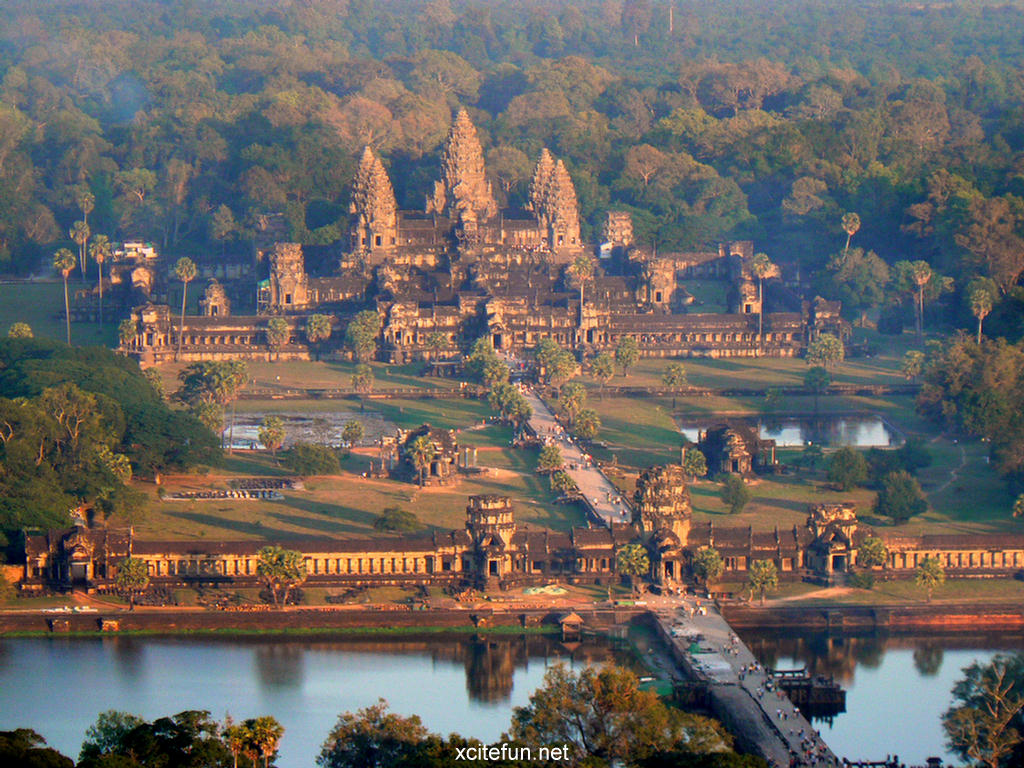
Photos of Cambodia's Angkor Vat Temple

Now the fight for Ayodhya has taken a new turn and it looks like the Congress is tacitly backing the new gambit. We will have to wait and watch if AYODHYA [not to be fought] will ever free itself from the fights which are happening at different planes.

Link to the actual news article published in DNA on Nov 2nd 2010 can be read here 

Friday, October 29, 2010

Launch of BHAASHYA

You might be aware of my recent posts on hindu scriptures, especially my attempt to analyze Brahma sutras. After serious thought I have decided to keep this blog for sharing my general views (as i have done so far) and create a new platform for discussing and analyzing the former topic. In this direction i have created a new blog and have moved all my articles related to the said topic to the new blog. Have a look at it and give your suggestions/comments there

The new blog is named BHAASHYA [http://bhaashya.blogspot.com/] which means commentary, which closely relates to my idea of analyzing the scriptures.

Thursday, August 12, 2010

Independence Day - A Day to Act

15th of August 2010 we celebrate the 63rd Independence day. The generation who saw this country get the independence on 15th August 1947 are leaving behind memories of the day. With days passing by we may end up with no one from the generation physically there to explain it. But before that why should there be someone to explain it, After all a country is not about just one generation.

The independence day is a special day for us. It is the day when India emerged as a Geo-political entity. A country had to be built from its roots [I write this with the information I have read/heard from books/people which/who have recorded/witnessed the day]. If a country had to be built, then it must not have existed before. If that is the case then what was India before? What were its roots?

In today's world, by birth we belong to one country or the other. This is one decision which we have to accept whether we like it or not. Each individual (human being) on this earth has an objective (right/wrong) for his life with exceptions where people spend their entire life searching for the objective. Considering the population our country has, and the amount of objectives the confused minds in it create, it is really a hard mathematical problem to get a set of common objectives (although not impossible). In this case is there any chance to think about a common objective for the country? If “YES” Who should fix such an objective for the country? If “NO”, then as responsible citizens where are we expecting the country to move forward?

A precursor for any individual who is fixing an objective for his life, is to get inspired about it. For e.g. if the objective of my life is to become a very good engineer then such a thought should have come to my mind only because something that inspired me to become an engineer. That something can be anything like “I read an inspirational story about an engineer”, “Some one from the family is an engineer who has got fame/name/money”, “Watched a movie about an engineer who changed the world” etc. Inspiration comes as we acquire experience and information from numerous sources (parents, teachers, books, friends etc) through out our life.

Now, how does a country get inspiration to decide its objective. When I say the country gets inspiration, it means how do people in the country get inspired for the country and decide a road map for its progress. Such an inspiration for the country can be got only by speaking of its rich history and culture which has been the foundation of what we are enjoying now. A land with such a background has produced men and women the world would never forget. We being the modern citizens of the country should always remember that and feel blessed to have taken birth in this land. An environment that nurtures dynamic heroes of the future should be cultivated by us. We should teach everyone about the rich history of the country and how each individual has a crucial role in determining the road map for the country. Together we should all work together to fight the diseases plaguing the country like corruption, population, civic sense, illiteracy, poverty etc. and for the betterment of education system, civic sense, governance, disaster management etc.

It is a memorable day (15th August) as some of us think, but should we celebrate it like yet another weekend or should we brainstorm and discuss ideas which we can implement to lay a road for the colorful future of the country again to remembered for its rich past and culture some 500 years from now.

Many eminent people have started contributing in this direction significantly. I have started my very minute and negligible contribution through Education Informal with the support of my parents, family and friends. My life is complete if I can work with many such people to create a bright and colorful future for the country.

Monday, May 31, 2010

The land that resonates a wonder civilization

If someone had offered me a Time Machine i would have requested it to take me to 8000 BCE(before the common era)...
About the end of the last glacial age some 10,000 to 12,000 years ago(approx), temperature rose and the ice sheets started retreating over much of North America and Eurasia, as did the glaciers in the mountainous regions such as the Himalayas. A sight probably scary but exciting when waters deliriously roared down the Himalayas, bouncing on the Shivaliks and flooding the plains below. Hundreds of paleochannels small and large might have been flowing across the plains below. It might have been without purpose that nature's fury at the time might have cooled down gradually to give birth to one of most amazing, exciting, peace loving civilization that stood the test of time & fate. Although the civilization got buried under the heaps of sand the culture it taught stands even today as a testimonial to its ancestors who laid its foundation.

My grandfather Dr J Shivananda Sastry a firm believer in God was a sincere worshiper. He performed puja(form of worship) daily to the house deity and the saligrama. Kalasha puja is one among the rituals that are performed during the puja. It is done at the beginning of the complete puja ritual. It is done to worship water which will be poured over the idols. Since i was a kid I grew listening to the mantra recitations which my grand father used to do while performing the puja. The recitations were extracted from the four [Rig, Yajur, Sama, Atharvana] vedas. One of the hymns recited during this kalasha puja is of my interest in this article.

इमं मे गंगे यमुने सरस्वती सुतुद्रि स्तोमं सचात परुस्न्य अ |
असिक्न्य
मरुद्व्र्धे वितस्तयार्जिकिये स्र्नुःय अ सुसोमय
||

Imam me gange yamune sarasvati sutudri stomam sacata parusny a |
asiknya marudvrdhe vitastayarjikiye srnuhy a susomaya ||

I never knew what it meant till yesterday. It literally means the following

O Ganga, Yamuna, Sarasvati, Shutudri(Sutlej), Parushni(Ravi), hear my praise! Hear my call, O Asikni(Chenab), Marudvridha (Maruvardhan), Vitasta(Jhelum) with Arjikiya and Sushoma

The hymn is part of the Nadi sukta in Rig Veda which specifically contains praise for the rivers in Ancient India. The hymn is followed by the enumeration of Indus(sindhu) and its tributaries in the west.

Source: Wikipedia

It in fact paid tribute to the great rivers (most of them we still see on the landscape) which once flowed full throttle and were probably the life lines of civilization which our ancestors were part of. The most amazing aspect of this hymn is it enumerates the list of rivers that flowed from the himalayas down to foot plains from east to west in the same order without any omissions and mistakes. A land that is bracketed by Ganga on the east and Sindhu on the west covers more than 1000 KM. It might look very simple to enumerate such a list in this modern day because of the sophistication science provides us(satellite imagery). Could we imagine how was it possible about 5000 years ago when people were defining formal methods to develop bronze tools. The people who composed the hymn were no village bard, but the most intelligent, rational beings probably existing during the time. I do not know how did they manage to enumerate all the rivers in the correct order(may be because of tight network of groups who inhabited these waters), i leave it open to the readers to find it out.

The most important of the above is the fact that the hymn which enumerates the rivers in the correct order is still recited today in spite of the fact that some of the rivers/tributaries mentioned in the hymn are dead and buried under the sands(probably seasonal flow exists).

Although i never asked my grand father why it was recited, but i feel that the hymn was recited to remember all the rivers that once were the lifelines of one of the most amazing, woderful, most remembered civilizations of all times probably from which we derive all our culture, thought, intelligence. We were a great land 5000 years back and we stood as role model to the entire world. We still are a great land and lets stand united and show to the world that we are still the role models.

Thursday, December 31, 2009

Kodagana Koli Nungitta

Couple of days back one of the best singer, composer who changed the outlook of Bhavageete(expressive poetry) and Janapada geete(folk songs) in the Kannada language passed away leaving behind many music lovers in Karnataka. It was a great loss to all of us. I am writing this article to remember the great icon who revolutionsed Bhavageete and Janapada geete.

I would rather call this man the saint singer, because his compositions for the writings of the saint philosopher Shishunala Sharif were so brilliant that it attracted a huge dancing crowd and his compositions added a shine to an already life filled poetry. Infact i was inspired to name this post after the title which simply became the second name for C Ashwath
Whenever i would listen to this song, i would always wonder what is the real meaning hidden in this song. The song starts with Kodagana Koli Nungitta, Nodava Thangi... which literally means the hen swalloed the monkey. At what period/era on this Earth would this be possible. The lyrics then continues saying Aadu aaneya nungi, Gode sunnava nungi... which literally means goat swalloed elephant and wall swalloed the lime water(used to paint the walls). What is Shishunala Sharif trying to communicate to the common people. After listening to the song again and again i unearthed what could be the real spirit, soul behind the poem. I will do a sincere effort here to give my commentary on the poem. Please comment on this article

Shishunala Shariefa lived in North Karnataka and so has used language/objects which are commonly seen in that part of the region. The poem starts with

Kodagana Koli nungitta, noddava thangi Kodagana Koli nungitta...

He says Oh sister, Hen has swallowed the Monkey. The poet starts of with a line that shows respect and dignity our motherland(India) has given to Women. He could have said Oh Brother! but instead has used the word sister to signify the role of women in imparting the right knowledge to the soceity. The hen being a bird literally cannot swallow the monkey but through this Shishunala says there are numerous things which we come across in our daily life which may look very small when looked at it physically but they have the ability to change an object which is bigger than them. As we get along the poem the real meaning behind such puzzled phrases becomes more clear. Then he says

Aadu Aaneya nungi, Gode sunnava nungi, Aadalu bandha patadadavala maddale nungita thangi.. Kodagana Koli nungitta..

The goat swalloed the elephant, the wall swallowed the paint, the drum swallowed the actor who came to enact a play. Paint being the protector of the wall, was swalloed by the wall. Without the drum the actor cannot enact his play, drum becomes a very important asset for an actor without which his profession becomes less attractive.

Ollu onakeya nungi, Kallu gutava nungi, Mellalu bandha mudhukiyannu nellu nungitta thangi.. Kodgana Koli nungitta...

Usually in north Karnataka in order to prepare chilli, turmeric etc powder there is a container made of stone called as Ollu. The material to be powdered is put into the container and then smashed by using a iron pole called as Onake. The iron pole is dropped again and again vertically on the material placed inside the stone container to powder it. So the iron pole swalloed the stone container means without the stone container the purpose of the iron pole is nothing. Similarly to grind rice, wheat flour there is a tool used. A stone slab circular in shape is placed on the floor. Above that another stone slab circular in shape and with the same diameter as the earlier one is placed. The slab on the top has a circular hole at the center where rice/wheat can be poured. There is a slot on the upper surface of the above slab where a wood stick is inserted. It is called as guta. The poet says the stone slabs swalloed the wooden stick. It means without the stone slab the wooden stick has no purpose there. Then he says the wheat swallowed the aged lady who had come to chew the food. This means an aged lady usually can't chew hard food because of the delicacy of the tooth. So wheat being a hard food becomes difficult to be chewed by the aged lady. We can see here the power of the language shishunala disha has used. It is very simple yet very powerful.

Hagga maggava nungi, Maggava lali nungi, Maggadoliruva annanannu maniyu nungitta thangi.. Kodagana koli nungitta...

Magga is a tool used to knit clothes/sarees. Lali is another tool used inside the Magga for knitting purpose. The poet says the rope swalloed the Magga, the magga swallowed the lali and the precious stone used inside the magga swallowed the person who does the knitting using the Magga. The poet depicts the inter dependency that exists between the objects. Without one of the them the person knitting the cloth will not be able to do anything. He is basically trying to say the importance of smaller things to our life even though they may seem to be of less importance because of their smaller size.

Gudda gaviyannu nungi, Gavi iruveya nungi, Govinda guruvina pada nannanu nungitta thangi.. Kodagana koli nungitta...

The poet with humility says his guru's (teacher's) feet swalloed him. Through this he offers his respects and also signifies that his life is inspired by the teachings of his teacher. It was his teacher who taught him what life is all about. The poet is offering his gratitude towards his teacher. He compares his teacher's feet swalloing him to a hill swalloing the cave in it. The cave swalloing the ant. He compares his teacher's feet to a hill and himself to an ant.

Shishunala sharifa has used very simple daily spoken words in his poem to communicate a very strong message to the reader's. Although after reading the poem in this article if you feel less interested then probably a music interleaved version by C Ashwath gives the shine to an already life filled poem. Enjoy the orginal song from the movie shishunala sharifa composed by C Ashwath and sung by Shimoga Subbana


Wednesday, December 23, 2009

What is good?

First my apologies for scripting my thought after a long time
In the last post, i had discussed about objectives. I had concluded saying that the objective must lead us to good. Before setting such an objective do we know what good is. Is good absolute or relative?
A person may think working sincerely is good, another may think drinking, smoking is good. A thief may think robbing successfully is good and so on. So if you question yourself you may think which is good for you may not be good for others. The term good becomes more of a personal asset. For the matter when we say something is good, doesn't mean it is good throughout our lives. Our tagging of good is just temporal and is time variant. For e.g. we have bought a car today. If anybody asks us how is the car? We say "It is good". Say after 5 years if somebody asks the same question, we would rather say "I am planning to exchange it with the new one". The tagging of something as good has changed with time. Another e.g. When we go to a sweet shop and eat a sweet, we feel it is good and may order for another. Some people may stop eating the second sweet but some may still go on until their love for the sweet has just saturated. So a sweet which was once a good entity may not retain its goodness after some duration. If that is the case then what is good? is it just a time varying temporal parameter? If so then how on this earth can we ever set a objective which leads us to good!
We being part of a society, a country, a species must and should have a unified definition for good which in fact is good for everyone. Good as translated in Kannada is "ಒಳ್ಳೆಯದು (spell it as 'olleyadu')" and as translated in Sanskrit is "सत् (spell it as 'Sat')" when traced back to their origin (the source word ಉಳ್(ul) in kannada and सत्(Sat) in sanskrit) means Eternal (ageless, endless) something which has no decay, no death. So can we tag something as good on this earth which must be ageless, endless, which has no decay, no death? We should also note that our Earth is not endless, it is not ageless, it has death! So can we find what is good and if at all we can find that then we can attempt to fix our objective which will lead us to good...

Monday, October 26, 2009

Goals are as different as we are

As per recent reports the total population on earth is 6.793 billion. Do you think all these people have a single goal!

In this vast world, it is difficult to find a person very much similar to another. Even if you find two very similar looking humans, they may vary drastically in many other features like their voice, tastes, listening capabilities, interests, thought process, behavior ... So with such wide and varied set of homo sapiens can we ever think of a common goal to all.

Fixing an objective/goal in one's life has to be done by each one us and no one else can decide it for us. But how will you ever know what your objective is? whether your objective is good? whether your objective is right? whether your objective is truthful?. When we cried for the first time on this earth, did we once for all decide we want to become engineers, doctors, teachers, businessmen, laborers... NO, through out our lives many people have influenced us directly/indirectly to choose the right path. Parents, Guardians, Teachers, Friends, Elders, Legends, Books ...

When we go to a store to buy clothes, food items what do we do?. We list out the commodities we want. We quantify them by counting the number of members in the family. We select them based on our tastes and interests. When we go to the store, the store keeper suggests us the commodities which match our interests. Here shopkeeper is like anyone of the above mentioned set of people. The commodities in the shop are like the different objectives and we are the people buying them in the shop. The people who inspire us to set a goal/objective are like sign boards who tell us where to go.

The objectives/goals are progressive and they get revised at each turn of our lives. It is just like climbing a hill. First we reach the foot of the hill, then we climb to certain distance and take rest, then we come close to the summit and so on. But the most important of all these is the first step we take towards the long journey. So how should the first step be? Let us take this question progressively. Let us assume the first step should be such that it should lead us to good. But what is good? How do you define good? Can you define?