Monday, May 2, 2011

The Ugly, The Bad and The Good

I am not narrating here the 1966 Italian/Spanish epic spaghetti western film directed by Sergio Leone, starring Clint Eastwood.

September 11th, 2001 very familiar as 9/11 ramped up the fight against terrorism when US government declared the WAR ON TERROR. Post attacks the then president of US George W. Bush addressing the nation said

"Good evening. Today, our fellow citizens, our way of life, our very freedom came under attack in a series of deliberate and deadly terrorist acts. ... Thousands of lives were suddenly ended by evil, despicable acts of terror. The pictures of airplanes flying into buildings, fires burning, huge structures collapsing, have filled us with disbelief, terrible sadness, and a quiet, unyielding anger. These acts of mass murder were intended to frighten our nation into chaos and retreat. But they have failed; our country is strong. ... America has stood down enemies before and we will do so this time. None of us will ever forget this day. Yet, we go forward to defend freedom and all that is good and just in our world. Thank you. Good night. And God bless America" [Full transcript can be read here]

Following the events that happened on 9/11, US and its allies launched a massive WAR ON TERROR to dismantle Al-Qaeda [responsible for the terror 9/11 attacks in US]  and ending its use of Afghanistan as a base for terrorist operations. Since then US armed forces have searched for the mastermind of 9/11 attacks Osama Bin Laden.

In 1996, six years before the 9/11 attacks happened, Osama Bin Laden had written what he calls a fatwa [is a religious opinion concerning Islamic law issued by an Islamic scholar] titled "Declaration of War against the Americans Occupying the Land of the Two Holy Places". In the fatwa he starts saying

"Praise be to Allah, we seek His help and ask for his pardon. we take refuge in Allah from our wrongs and bad deeds. Who ever been guided by Allah will not be misled, and who ever has been misled, he will never be guided. I bear witness that there is no God except Allah-no associates with Him- and I bear witness that Muhammad is His slave and messenger. ... It should not be hidden from you that the people of Islam had suffered from aggression, iniquity and injustice imposed on them by the Zionist-Crusaders alliance and their collaborators; to the extent that the Muslims blood became the cheapest and their wealth as loot in the hands of the enemies. Their blood was spilled in Palestine and Iraq. The horrifying pictures of the massacre of Qana, in Lebanon are still fresh in our memory. Massacres in Tajakestan, Burma, Cashmere, Assam, Philippine, Fatani, Ogadin, Somalia, Erithria, Chechnia and in Bosnia-Herzegovina took place, massacres that send shivers in the body and shake the conscience. All of this and the world watch and hear, and not only didn't respond to these atrocities, but also with a clear conspiracy between the USA and its' allies and under the cover of the iniquitous United Nations, the dispossessed people were even prevented from obtaining arms to defend themselves. ... " [Full transcript can be read here]

The US and its allied forces have searched round the clock for the man who issued the above fatwa and today after 10 years of WAR ON TERROR they killed him in the very middle of Pakistan where he was happily taking shelter. 

Obama the president of US, addressing the Nation confirmed the death of Osama. 

"Good evening. Tonight, I can report to the American people and to the world that the United States has conducted an operation that killed Osama bin Laden, the leader of al Qaeda, and a terrorist who's responsible for the murder of thousands of innocent men, women, and children. It was nearly 10 years ago that a bright September day was darkened by the worst attack on the American people in our history. ... On September 11, 2001, in our time of grief, the American people came together. We offered our neighbors a hand, and we offered the wounded our blood. We reaffirmed our ties to each other, and our love of community and country. On that day, no matter where we came from, what God we prayed to, or what race or ethnicity we were, we were united as one American family. We were also united in our resolve to protect our nation and to bring those who committed this vicious attack to justice. ... And so shortly after taking office, I directed Leon Panetta, the director of the CIA, to make the killing or capture of bin Laden the top priority of our war against al QaedaUnited States is not -- and never will be -- at war with Islam. I've made clear, just as President Bush did shortly after 9/11, that our war is not against Islam. Bin Laden was not a Muslim leader; he was a mass murderer of Muslims. Indeed, al Qaeda has slaughtered scores of Muslims in many countries, including our own. So his demise should be welcomed by all who believe in peace and human dignity. ... The American people did not choose this fight. It came to our shores, and started with the senseless slaughter of our citizens ...

The cause of securing our country is not complete. But tonight, we are once again reminded that America can do whatever we set our mind to. That is the story of our history, whether it's the pursuit of prosperity for our people, or the struggle for equality for all our citizens; our commitment to stand up for our values abroad, and our sacrifices to make the world a safer place. Let us remember that we can do these things not just because of wealth or power, but because of who we are: one nation, under God, indivisible, with liberty and justice for all. Thank you. May God bless you. And may God bless the United States of America."

Truly a President's speech. [Full extract can be read here]

As I attentively heard the speech of Obama, I recalled another country which was suffering terror at a magnitude which stands highlighted and incomparable to 9/11. It is our very own country India. Each of those words which Obama spoke, resonated the killings of million of Indians in my mind. It took 10 years for US to give justice to the 3000 innocent human beings who were killed in 9/11 attacks. It has taken more than 60 years and it is still counting for our country to give justice to countless Indians who have lost lives because of Terror.

I was just thinking why is their such lethargy?, why is there so much negligence?, why are our minds not concerned about the deaths of fellow citizens?, why is there no such rigorous action to curb terrorism? As always we do not have any specific answers to these questions!

Indians have always believed in the Eternal justice given by GOD. The justice given by human beings is temporal. It is that eternal justice which should give us the inspiration to answer some of the above questions. The WAR ON EVIL is not over but it repeats until eternal justice prevails ...

Bhagavadgeeta, Chaper 4, Verse 7 and Verse 8

yada yada hi dharmasya
glanir bhavati bharata
abhyutthaanam adharmasya
tadaatmanam srjamy aham


Whenever there is decline of Dharma (righteousness).. and rise of Adharma (unrighteousness);To protect the virtuous..to destroy the wicked and to re-establish Dharma,I manifest myself, oh decedent of Bharata

paritraanaaya sadhunaam vinaashaaya cha dushkrritaam dharmasamsthaapanaarthaaya sambhavaami yuge yuge..

For the protection of the devotees and the annihilation of the miscreants and to fully establish the righteousness, I appear million after million...

Wednesday, February 9, 2011

An Ideal Offering

I was recently going through a series of articles being put on the website of Sringeri Mutt (www.sringeri.net) under a section called Upadesha Lahari. It contains translations, audio, video of lectures of current and former Jagadgurus of Sringeri Mutt. The articles published there are really good and meant for common men who are interested in spiritual elevation.

Here I summarize one of those articles which is a translation of Anuraga Bhashanam (lecture on devotion) delivered by Jagadguru Shankaracharya Sri Bharati Tirtha Mahaswamiji at Kapaleeshwara Temple in Chennai during his Vijaya Yatra in 1986

To worship God (Bhagavan) and thereby become the recipient of His Grace is what has been traditionally regarded for thousands of years as an ideal to aspired for. It is our responsibility to keep up that tradition.

यस्याहुरागमविद: परिपूर्णशक्ते-
रंशे कियत्यपि निविष्टममुं प्रपञ्चम् ।
तस्मै तमालरुचिभासुरकन्धराय
नारायणीसहचराय नम: शिवाय ॥

Sri Shankara has conveyed much about how Iswara should be worshiped. Normally, when we visit a temple, we do not go empty-handed; we take some offerings with us for Ishwara. What is the most fitting offering to Bhagavan? The reply given by Sri Sankara in the form of a prayer to Ishwara is quite interesting.

“O, Lord, what shall I offer You? What competence do I possess for offering anything to You? What is the object not possessed by You which I can give You?”

Offering gold, gift of money, modern articles, cool sandal wood paste etc to God is not appropriate. Bhagavatpada analyzed all these options and came to a conclusion.

“O, Lord, I am not competent to offer anything to You. However, there is an object, which I am going to dedicate to You. It is my mind.”

Many raise the objection, “It is not possible to offer the mind to Ishwara. If the mind were to be an external object, we could take it and place it at His feet. But it is not so. We cannot physically handle the mind. How then can we dedicate our minds to Ishwara?” The answer is, “By keeping Ishwara in our minds at all times”. The import is that a person must ever engage himself in thinking of Ishwara. He should not entertain any other thought in his mind.

Is it possible to achieve such a mental state?
In Lord Krishna’s time, the Gopis were ever contemplating on Him. We read in the Bhagavata that the minds of the Gopis did not think of anything or anyone, but the Lord. A devotee has composed a beautiful verse about the condition of the Gopis.

विक्रेतुकामा किल गोपबाला मुरारिपादार्पितचित्तवृत्ति: ।
दध्यादिकं मोहवशादवोचद्गोविन्द दामोदरमाधवेति ॥

The Gopis earned their living by selling milk and curds. In order to attract the attention of people to the items the Gopis had to loudly utter, “Milk! Curds!”. Instead, the Gopis shouted, “O, Govinda! O, Damodara! O, Madhava!” and so on. They set out to sell milk and curds but as their minds were ever engaged in the thought of the Lord, the words “milk” and “curds” did not come out of their mouth. They were uttering the names of the Lord.

God will accept whatever one offers to Him if one’s mind is ever engaged in thinking of Him.
Bhagavan has declared in the Gita:

पत्रं पुष्पं फलं तोयं यो मे भक्त्या प्रयच्छति ।
तदहं भक्त्युपहृतमश्रामि प्रयतात्मन: ॥

“I will accept whatever one offers Me with true devotion.”

Though it is only the knowledge of the Self which leads to liberation, a person who is not competent to tread the path of knowledge should worship Ishwara with devotion. What, indeed, will be the fate of a person who lacks the competence and the opportunity to directly get the knowledge of the Self and yet does not tread the path of devotion?

सा त्वस्मिन्परमप्रेमरूपा ॥

So say the Sastras. One must direct one’s attention exclusively to the Lord; such a state of mind is termed as devotion.

Devotion is not a path meant only for common folk. It is not as if the wealthy ones need not be devoted. All are equal from the standpoint of Ishwara. It will be a grave sin if one were to think that one need not bow down to Ishwara just because one is affluent.

Please read the complete translation of the Bhashanam at the following link

Wednesday, January 5, 2011

Twenty Five days and Three celestial puzzles

December 22nd 2010, I was at my home wearing a sweater, covering myself with a blanket standing on the terrace of my house gazing at zillions of stars over my head trying to solve three celestial puzzles that looked to be posed by GOD over the next 25 days.

DECEMBER 22nd 2010

December 22nd, a special day of astronomical significance generally not known to many except if you have some interest in astronomy or sky gazing. It is the day when the people in the higher latitudes (Europe, Russia, North China, North America, Canada etc. ) experience the shortest day and the longest night. This day is referred to as the winter solstice. If you are thinking why will there be a shortest day, then you have landed on the right page to understand that.

Earth has an axial tilt of 23.45 degrees. The winter solstice occurs when the earth's axial tilt is farthest away from the sun. It is because of this axial tilt, the northern hemisphere will have winter and the southern hemisphere has summer and vice versa. The same axial tilt will cause the shortest day and longest night in northern hemisphere AND longest day and shortest night in southern hemisphere on this day. 


One interesting question that might arise in your mind is why is it called Winter solstice even though southern hemisphere is enjoying its summer! Astronomical events are recorded w.r.t Coordinated Universal Time(UTC) which in essence is Greenwich Mean Time(GMT). Since Greenwich is in northern hemisphere, winter/summer solstice is named after the season that occurs in northern hemisphere.


JANUARY 4th 2011

Ten days after the solstice, into the new decade on January 4th 2011, partial solar eclipse was observed in Middle East countries like Dubai, Abu Dhabi, Muscat, UAE (United Arab Emirates), Qatar, Bahrain, Riyadh, etc. We have studied since school days that a solar eclipse occurs, when moon comes in between the sun and the earth i.e. All the three heavenly bodies stand in a single line. I want to share couple of interesting facts about eclipses which most people might not know. The orbit of the moon around the earth is tilted at an angle of 5.14 degrees from the plane of earth's rotation around the sun. The orbit of the moon intersects the earth's orbital plane at two points called the ascending node and descending node. When the moon is at either of these two points, the eclipse(solar/lunar) will occur. In Indian astronomy the ascending node is the all famous RAHU and the descending node is the all famous KETU.


Another interesting fact is that these nodes(rahu/ketu) are not static. They are regressing in the clockwise direction. This is because the oribit of the moon around the Earth is wobbling. It is because of the regressing, the eclipses do not occur periodically at a particular date every year.

JANUARY 15th 2011

Mostly known in India as Makara Sankranthi, Pongal, Bhogi etc, this day has been celebrated from the past 6000 years. It marks the beginning of the Uttarayana(travel to north).

Throughout the year if you keep recording the position of the sun w.r.t distant constellations which generally is the zodiac constellations, we can observe that the sun keeps moving from one zodiacal constellation to another which is seen as sun's background. The day when sun enters a new constellation, it is called a sankramana. Similarly on January 15th the sun enters the constellation of capricorn(makara), hence it is called the makara sankramana or sankranthi.


In this screen captured from stellarium, we can see the sun entering the Capricornus(makara) constellation

The zodiac belt which consists of 12 constellations circling the earth, through which the sun takes its yearly path appears to be tilted at an angle of 23.45 degrees because of the earths axial tilt as said in the beginning of the article. 


 (left)The zodiac symbols, (right)the zodiac belt tilted at an angle of 23.45 degrees from the orbital plane of the earth

The sun as it moves across the zodiac will have to take an ascending path and then the descending path. It is on January 15th the Sun starts its ascending path with respect to the zodiac i.e. its travel towards north and hence called the beginning of Uttarayana.

Next time when you look up at the sky, hope you will not miss anymore puzzles...

Thursday, December 23, 2010

EI with a refreshing look for the year 2011

2010 was a very good year for Education Informal (EI). Through our school visit program we reached around 500+ students conducting around 10 sessions across various schools in Bangalore. In this year, the special focus was on conducting more Vedic Mathematics sessions and training young students with the fundamentals of Vedic Mathematics. We got positive feedback about our sessions from students, teachers and parents. We also collaborated with Vision Bangalore to conduct free healthcare camps at schools. 

Education Informal is one of the 12 NGOs to be featured in 2011 calendar based on community service theme [The calendar is brought out by Vakil builders]. IBM also recognized Education Informal for its initiative to introduce Vedic Mathematics to young students across various schools in Bangalore. Soon an article about EI will be published in the IBM website. 

New EI website was launched to project EI activities in a better way on the WWW. The new website is intended to reach volunteers, students, and other members who intend to contribute under the EI platform. EI will be focusing on introducing new sessions/programs and broadening its school visit program to higher grades. We thank all the people who have helped us to conduct our programs/sessions through out the year. We look forward to work with you all in the coming year 2011. 

WISH YOU A VERY HAPPY AND PROSPEROUS NEW YEAR 2011

Saturday, November 6, 2010

An Insight into Health care in today's India

Since the beginning of Ayurveda till today medicine in India has gone through numerous changes. The term Ayurveda was given to the ancient Indian system of medical education literally meaning the knowledge of life. Although origin of Ayurveda is uncertain, it is considered to be a branch of vedas. 
 
The evolution of medical sciences in ancient India has been difficult to follow accurately. The two monumental treatises Charaka samhita and Sushruta samhitaa written by Charaka (Physician) and Shushruta (Surgeon) respectively are  considered to be the two basic treatises considered to this date for practitioners of Ayurvedic medicine in India. In ancient India medical education was institutionalized. The two well known centers for medical education in ancient India were the residential universities of Takshashila and Nalanda. Both these universities offered a well organized institutional type of training to its students  intermingled with Gurukula system with a Guru taking under him a fixed number of students. 
 
In medieval times, it is difficult to understand how a system of medicine which had reached great heights in the surgical as well as medical side, in the course of centuries faded away. Not to despair we still have doctor s  studying and practicing Ayurveda in India and abroad. The British rule in India marked the advent of Western medicine into India. During their rule, the British passed various acts for the improvement of public health in the country. Even after India got its Independence, the western system of medicine which had gained world wide acceptance by then got more support from the Governments that got formed.

Today Bachelor of Medicine, Bachelor of Surgery or in Latin Medicinae Baccalaureus, Baccalaureus Chirurgiae (MBBS) is awarded as a first professional degree upon graduation from medical school in medicine and surgery by universities across the world that follow the tradition of United Kingdom(UK). 

Recently getting into medical schools has been a challenge to most of the aspirants in India. The tough competition in the entrance tests, huge amount of fees, arduous and long course, low initial salaries have resulted in a drastic reduction of aspirants who are willing to choose a course in medicine. The lucrative salaries offered to Engineers in India and abroad which have got the benefits of less fees, comparatively shorter duration of the course, high initial salaries, job offers before graduation make students mesmerized to opt for Engineering courses unless for a some really interested aspirants. 

It is no doubt that with so much of trouble that the doctors would have taken for their current position they charge for services according to their whims and fancies. I heard from a friend of mine who has done his MBBS, that in US and UK doctors spend a fixed amount of time for treating patients and plan the remaining amount of time for research and evolving themselves for new approaches in medicine[strict formal process es are laid by the authorities]. In contrast, in India most of the doctors spend their time treating patients without properly engaging themselves in research. I also heard from my friend that, a doctor who does not participate in research and seminar for certain duration will be derecognized. As to this, we should now understand how many of the doctors around us are recognized!  We also lack a proper central system to manage health records of patients which might save precious time of doctors by avoiding unnecessary dialogues with patients about the history of the disease and related details.

I always wonder, in spite of having the second largest population in the world, sanity conditions being below par causing illness to most of the population, India has not been a favorite in medicine learning. There is a lot of disparity among the disciplines of Engineering, Medicine and Basic sciences. I always compare them to Cricket and other forms of sports played today in India.

As we are beginning to step into the 21st  century, we should tactically solve this problem of disparity and provide a more reasonable and justified solution which offers equal opportunities to all sections of society to pursue education based on healthy competition  rather than on mundane things like end result(payment), course fees, status etc. Although i may sound superficial without any such thought, our contribution to the field of medicine may fade away and our medical processes might become more diluted.

Wednesday, November 3, 2010

The unconquerable land


Ayodhya a land which has grown to international importance, has its name come from the sanskrit root word yudh, meaning "fight" or "wage war" and it translates to either "not to be fought" or, less literally, "unconquerable." It may seem to anyone that it has grown to importance for its root origin (fight, wage war) rather than for its complete meaning (not to be fought). 

Most of us are aware of the history of events that took place at Ayodhya way back since 1992 when Babri masjid was demolished till the recent Allahabad HC verdict in 2010. Without touching any of the above known events there is a recent development reported in a news paper which i thought of sharing with my view point. 

There has always been a campaign to build a Rama's temple in Ayodhya by VHP, RSS and BJP. Chandrakant Sompura, Architect was entrusted with the designing and construction of the Rama's temple by VHP chief Ashok Singhal. The architecture of the temple designed by him has been well known to most of us. 


Parallel to the above campaign there has been an attempt to start a new campaign to build Rama's temple in Ayodhya which has been slow but surely taking shape. But this campaign is not started by RSS, VHP or BJP.    It is Swami Swaroopananda Saraswati, Shankaracharya of the Jyotipeeta (Badrikashram) and Dwarakapeeta (Gujarat) [two of the four centers of Advaita learning established by Sri Sankaracharya] who has taken this initiative.


He has been linked to politics and is perceived to have been a close ally of former Prime Minister Rajiv Gandhi and had close relations with all the three generations of Gandhi family. Sources said Swaroopanand's new plan has the unspoken support of the Congress leadership. The idea is to wrest the temple initiative from the saffron brigade and isolate BJP, VHP and the Sangh on this issue in the aftermath of the September 30 Allahabad high court order. 

Swami Swaroopanand has unveiled a new plan to build a temple dedicated to “Brahma Ram (Ram as God) as opposed to the adarsh (ideal) or purushottam Ram as advocated by VHP. The design for the new temple was unveiled at the conclave of shankaracharyas held at Sringeri earlier this year.

The latter essentially recognises a mortal or human form of Ram which the shankaracharya finds unacceptable.
“A temple in the name of adarsh Ram can be a tourist spot but not a place for worship. Only a temple consecrated to Ram in divine form as Brahma Ram will be acceptable to Hindus,” Swaroopanand told a group of mediapersons at his Kalindi Colony residence in Delhi.

The shankaracharya also pointed out that VHP's temple plan would never be realised due to the vaastu dosh (architectural fault) in its Ram temple design.He said the shilanyas held by VHP in November 1989 also suffered from vaastu dosh as it had been done for a Sinha dwar (main entrance to the shrine), far from the Ram Janmasthan (birthplace) and in the south direction, which was “inauspicious”.

Swaroopanand’s campaign is aimed at getting the temple built by the Akhil Bharatiya Ramalay Nirman Samiti. This would effectively nix the saffron brigade’s plans to get the temple constructed by the VHP-controlled Ram Janmabhoomi Nyas.

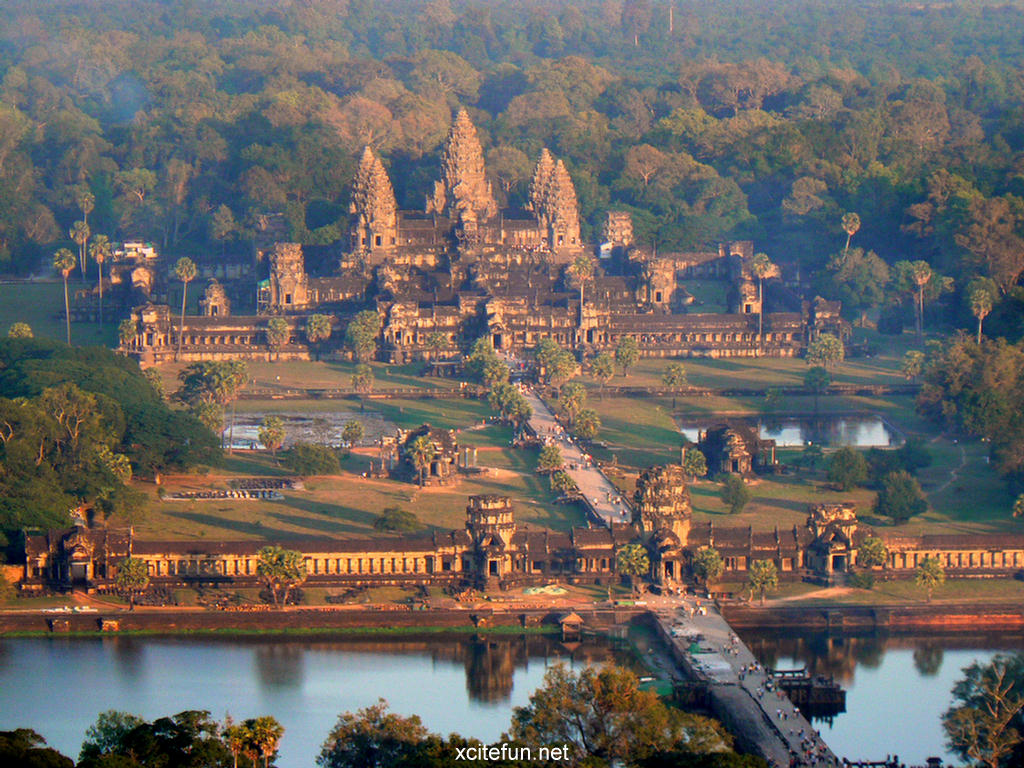
The new temple's design, proposed by Akhil Bharatiya Ramalay Nirman Samiti, is based on Cambodia's Angkor Vat Temple. The temple will be 350 ft high and have five gold plated spires built on top at a cost of Rs 100 crore. It will have a hall to accommodate 10,000 devotees at a time. There would be an extensive CCTV network that would help nine lakh devotees in the premises watch the prayers. There would be broadcast facilities for live telecast.


Photos of Cambodia's Angkor Vat Temple

Now the fight for Ayodhya has taken a new turn and it looks like the Congress is tacitly backing the new gambit. We will have to wait and watch if AYODHYA [not to be fought] will ever free itself from the fights which are happening at different planes.

Link to the actual news article published in DNA on Nov 2nd 2010 can be read here 

Friday, October 29, 2010

Launch of BHAASHYA

You might be aware of my recent posts on hindu scriptures, especially my attempt to analyze Brahma sutras. After serious thought I have decided to keep this blog for sharing my general views (as i have done so far) and create a new platform for discussing and analyzing the former topic. In this direction i have created a new blog and have moved all my articles related to the said topic to the new blog. Have a look at it and give your suggestions/comments there

The new blog is named BHAASHYA [http://bhaashya.blogspot.com/] which means commentary, which closely relates to my idea of analyzing the scriptures.

Thursday, August 12, 2010

Independence Day - A Day to Act

15th of August 2010 we celebrate the 63rd Independence day. The generation who saw this country get the independence on 15th August 1947 are leaving behind memories of the day. With days passing by we may end up with no one from the generation physically there to explain it. But before that why should there be someone to explain it, After all a country is not about just one generation.

The independence day is a special day for us. It is the day when India emerged as a Geo-political entity. A country had to be built from its roots [I write this with the information I have read/heard from books/people which/who have recorded/witnessed the day]. If a country had to be built, then it must not have existed before. If that is the case then what was India before? What were its roots?

In today's world, by birth we belong to one country or the other. This is one decision which we have to accept whether we like it or not. Each individual (human being) on this earth has an objective (right/wrong) for his life with exceptions where people spend their entire life searching for the objective. Considering the population our country has, and the amount of objectives the confused minds in it create, it is really a hard mathematical problem to get a set of common objectives (although not impossible). In this case is there any chance to think about a common objective for the country? If “YES” Who should fix such an objective for the country? If “NO”, then as responsible citizens where are we expecting the country to move forward?

A precursor for any individual who is fixing an objective for his life, is to get inspired about it. For e.g. if the objective of my life is to become a very good engineer then such a thought should have come to my mind only because something that inspired me to become an engineer. That something can be anything like “I read an inspirational story about an engineer”, “Some one from the family is an engineer who has got fame/name/money”, “Watched a movie about an engineer who changed the world” etc. Inspiration comes as we acquire experience and information from numerous sources (parents, teachers, books, friends etc) through out our life.

Now, how does a country get inspiration to decide its objective. When I say the country gets inspiration, it means how do people in the country get inspired for the country and decide a road map for its progress. Such an inspiration for the country can be got only by speaking of its rich history and culture which has been the foundation of what we are enjoying now. A land with such a background has produced men and women the world would never forget. We being the modern citizens of the country should always remember that and feel blessed to have taken birth in this land. An environment that nurtures dynamic heroes of the future should be cultivated by us. We should teach everyone about the rich history of the country and how each individual has a crucial role in determining the road map for the country. Together we should all work together to fight the diseases plaguing the country like corruption, population, civic sense, illiteracy, poverty etc. and for the betterment of education system, civic sense, governance, disaster management etc.

It is a memorable day (15th August) as some of us think, but should we celebrate it like yet another weekend or should we brainstorm and discuss ideas which we can implement to lay a road for the colorful future of the country again to remembered for its rich past and culture some 500 years from now.

Many eminent people have started contributing in this direction significantly. I have started my very minute and negligible contribution through Education Informal with the support of my parents, family and friends. My life is complete if I can work with many such people to create a bright and colorful future for the country.

Monday, May 31, 2010

The land that resonates a wonder civilization

If someone had offered me a Time Machine i would have requested it to take me to 8000 BCE(before the common era)...
About the end of the last glacial age some 10,000 to 12,000 years ago(approx), temperature rose and the ice sheets started retreating over much of North America and Eurasia, as did the glaciers in the mountainous regions such as the Himalayas. A sight probably scary but exciting when waters deliriously roared down the Himalayas, bouncing on the Shivaliks and flooding the plains below. Hundreds of paleochannels small and large might have been flowing across the plains below. It might have been without purpose that nature's fury at the time might have cooled down gradually to give birth to one of most amazing, exciting, peace loving civilization that stood the test of time & fate. Although the civilization got buried under the heaps of sand the culture it taught stands even today as a testimonial to its ancestors who laid its foundation.

My grandfather Dr J Shivananda Sastry a firm believer in God was a sincere worshiper. He performed puja(form of worship) daily to the house deity and the saligrama. Kalasha puja is one among the rituals that are performed during the puja. It is done at the beginning of the complete puja ritual. It is done to worship water which will be poured over the idols. Since i was a kid I grew listening to the mantra recitations which my grand father used to do while performing the puja. The recitations were extracted from the four [Rig, Yajur, Sama, Atharvana] vedas. One of the hymns recited during this kalasha puja is of my interest in this article.

इमं मे गंगे यमुने सरस्वती सुतुद्रि स्तोमं सचात परुस्न्य अ |
असिक्न्य
मरुद्व्र्धे वितस्तयार्जिकिये स्र्नुःय अ सुसोमय
||

Imam me gange yamune sarasvati sutudri stomam sacata parusny a |
asiknya marudvrdhe vitastayarjikiye srnuhy a susomaya ||

I never knew what it meant till yesterday. It literally means the following

O Ganga, Yamuna, Sarasvati, Shutudri(Sutlej), Parushni(Ravi), hear my praise! Hear my call, O Asikni(Chenab), Marudvridha (Maruvardhan), Vitasta(Jhelum) with Arjikiya and Sushoma

The hymn is part of the Nadi sukta in Rig Veda which specifically contains praise for the rivers in Ancient India. The hymn is followed by the enumeration of Indus(sindhu) and its tributaries in the west.

Source: Wikipedia

It in fact paid tribute to the great rivers (most of them we still see on the landscape) which once flowed full throttle and were probably the life lines of civilization which our ancestors were part of. The most amazing aspect of this hymn is it enumerates the list of rivers that flowed from the himalayas down to foot plains from east to west in the same order without any omissions and mistakes. A land that is bracketed by Ganga on the east and Sindhu on the west covers more than 1000 KM. It might look very simple to enumerate such a list in this modern day because of the sophistication science provides us(satellite imagery). Could we imagine how was it possible about 5000 years ago when people were defining formal methods to develop bronze tools. The people who composed the hymn were no village bard, but the most intelligent, rational beings probably existing during the time. I do not know how did they manage to enumerate all the rivers in the correct order(may be because of tight network of groups who inhabited these waters), i leave it open to the readers to find it out.

The most important of the above is the fact that the hymn which enumerates the rivers in the correct order is still recited today in spite of the fact that some of the rivers/tributaries mentioned in the hymn are dead and buried under the sands(probably seasonal flow exists).

Although i never asked my grand father why it was recited, but i feel that the hymn was recited to remember all the rivers that once were the lifelines of one of the most amazing, woderful, most remembered civilizations of all times probably from which we derive all our culture, thought, intelligence. We were a great land 5000 years back and we stood as role model to the entire world. We still are a great land and lets stand united and show to the world that we are still the role models.

Thursday, December 31, 2009

Kodagana Koli Nungitta

Couple of days back one of the best singer, composer who changed the outlook of Bhavageete(expressive poetry) and Janapada geete(folk songs) in the Kannada language passed away leaving behind many music lovers in Karnataka. It was a great loss to all of us. I am writing this article to remember the great icon who revolutionsed Bhavageete and Janapada geete.

I would rather call this man the saint singer, because his compositions for the writings of the saint philosopher Shishunala Sharif were so brilliant that it attracted a huge dancing crowd and his compositions added a shine to an already life filled poetry. Infact i was inspired to name this post after the title which simply became the second name for C Ashwath
Whenever i would listen to this song, i would always wonder what is the real meaning hidden in this song. The song starts with Kodagana Koli Nungitta, Nodava Thangi... which literally means the hen swalloed the monkey. At what period/era on this Earth would this be possible. The lyrics then continues saying Aadu aaneya nungi, Gode sunnava nungi... which literally means goat swalloed elephant and wall swalloed the lime water(used to paint the walls). What is Shishunala Sharif trying to communicate to the common people. After listening to the song again and again i unearthed what could be the real spirit, soul behind the poem. I will do a sincere effort here to give my commentary on the poem. Please comment on this article

Shishunala Shariefa lived in North Karnataka and so has used language/objects which are commonly seen in that part of the region. The poem starts with

Kodagana Koli nungitta, noddava thangi Kodagana Koli nungitta...

He says Oh sister, Hen has swallowed the Monkey. The poet starts of with a line that shows respect and dignity our motherland(India) has given to Women. He could have said Oh Brother! but instead has used the word sister to signify the role of women in imparting the right knowledge to the soceity. The hen being a bird literally cannot swallow the monkey but through this Shishunala says there are numerous things which we come across in our daily life which may look very small when looked at it physically but they have the ability to change an object which is bigger than them. As we get along the poem the real meaning behind such puzzled phrases becomes more clear. Then he says

Aadu Aaneya nungi, Gode sunnava nungi, Aadalu bandha patadadavala maddale nungita thangi.. Kodagana Koli nungitta..

The goat swalloed the elephant, the wall swallowed the paint, the drum swallowed the actor who came to enact a play. Paint being the protector of the wall, was swalloed by the wall. Without the drum the actor cannot enact his play, drum becomes a very important asset for an actor without which his profession becomes less attractive.

Ollu onakeya nungi, Kallu gutava nungi, Mellalu bandha mudhukiyannu nellu nungitta thangi.. Kodgana Koli nungitta...

Usually in north Karnataka in order to prepare chilli, turmeric etc powder there is a container made of stone called as Ollu. The material to be powdered is put into the container and then smashed by using a iron pole called as Onake. The iron pole is dropped again and again vertically on the material placed inside the stone container to powder it. So the iron pole swalloed the stone container means without the stone container the purpose of the iron pole is nothing. Similarly to grind rice, wheat flour there is a tool used. A stone slab circular in shape is placed on the floor. Above that another stone slab circular in shape and with the same diameter as the earlier one is placed. The slab on the top has a circular hole at the center where rice/wheat can be poured. There is a slot on the upper surface of the above slab where a wood stick is inserted. It is called as guta. The poet says the stone slabs swalloed the wooden stick. It means without the stone slab the wooden stick has no purpose there. Then he says the wheat swallowed the aged lady who had come to chew the food. This means an aged lady usually can't chew hard food because of the delicacy of the tooth. So wheat being a hard food becomes difficult to be chewed by the aged lady. We can see here the power of the language shishunala disha has used. It is very simple yet very powerful.

Hagga maggava nungi, Maggava lali nungi, Maggadoliruva annanannu maniyu nungitta thangi.. Kodagana koli nungitta...

Magga is a tool used to knit clothes/sarees. Lali is another tool used inside the Magga for knitting purpose. The poet says the rope swalloed the Magga, the magga swallowed the lali and the precious stone used inside the magga swallowed the person who does the knitting using the Magga. The poet depicts the inter dependency that exists between the objects. Without one of the them the person knitting the cloth will not be able to do anything. He is basically trying to say the importance of smaller things to our life even though they may seem to be of less importance because of their smaller size.

Gudda gaviyannu nungi, Gavi iruveya nungi, Govinda guruvina pada nannanu nungitta thangi.. Kodagana koli nungitta...

The poet with humility says his guru's (teacher's) feet swalloed him. Through this he offers his respects and also signifies that his life is inspired by the teachings of his teacher. It was his teacher who taught him what life is all about. The poet is offering his gratitude towards his teacher. He compares his teacher's feet swalloing him to a hill swalloing the cave in it. The cave swalloing the ant. He compares his teacher's feet to a hill and himself to an ant.

Shishunala sharifa has used very simple daily spoken words in his poem to communicate a very strong message to the reader's. Although after reading the poem in this article if you feel less interested then probably a music interleaved version by C Ashwath gives the shine to an already life filled poem. Enjoy the orginal song from the movie shishunala sharifa composed by C Ashwath and sung by Shimoga Subbana


Wednesday, December 23, 2009

What is good?

First my apologies for scripting my thought after a long time
In the last post, i had discussed about objectives. I had concluded saying that the objective must lead us to good. Before setting such an objective do we know what good is. Is good absolute or relative?
A person may think working sincerely is good, another may think drinking, smoking is good. A thief may think robbing successfully is good and so on. So if you question yourself you may think which is good for you may not be good for others. The term good becomes more of a personal asset. For the matter when we say something is good, doesn't mean it is good throughout our lives. Our tagging of good is just temporal and is time variant. For e.g. we have bought a car today. If anybody asks us how is the car? We say "It is good". Say after 5 years if somebody asks the same question, we would rather say "I am planning to exchange it with the new one". The tagging of something as good has changed with time. Another e.g. When we go to a sweet shop and eat a sweet, we feel it is good and may order for another. Some people may stop eating the second sweet but some may still go on until their love for the sweet has just saturated. So a sweet which was once a good entity may not retain its goodness after some duration. If that is the case then what is good? is it just a time varying temporal parameter? If so then how on this earth can we ever set a objective which leads us to good!
We being part of a society, a country, a species must and should have a unified definition for good which in fact is good for everyone. Good as translated in Kannada is "ಒಳ್ಳೆಯದು (spell it as 'olleyadu')" and as translated in Sanskrit is "सत् (spell it as 'Sat')" when traced back to their origin (the source word ಉಳ್(ul) in kannada and सत्(Sat) in sanskrit) means Eternal (ageless, endless) something which has no decay, no death. So can we tag something as good on this earth which must be ageless, endless, which has no decay, no death? We should also note that our Earth is not endless, it is not ageless, it has death! So can we find what is good and if at all we can find that then we can attempt to fix our objective which will lead us to good...

Monday, October 26, 2009

Goals are as different as we are

As per recent reports the total population on earth is 6.793 billion. Do you think all these people have a single goal!

In this vast world, it is difficult to find a person very much similar to another. Even if you find two very similar looking humans, they may vary drastically in many other features like their voice, tastes, listening capabilities, interests, thought process, behavior ... So with such wide and varied set of homo sapiens can we ever think of a common goal to all.

Fixing an objective/goal in one's life has to be done by each one us and no one else can decide it for us. But how will you ever know what your objective is? whether your objective is good? whether your objective is right? whether your objective is truthful?. When we cried for the first time on this earth, did we once for all decide we want to become engineers, doctors, teachers, businessmen, laborers... NO, through out our lives many people have influenced us directly/indirectly to choose the right path. Parents, Guardians, Teachers, Friends, Elders, Legends, Books ...

When we go to a store to buy clothes, food items what do we do?. We list out the commodities we want. We quantify them by counting the number of members in the family. We select them based on our tastes and interests. When we go to the store, the store keeper suggests us the commodities which match our interests. Here shopkeeper is like anyone of the above mentioned set of people. The commodities in the shop are like the different objectives and we are the people buying them in the shop. The people who inspire us to set a goal/objective are like sign boards who tell us where to go.

The objectives/goals are progressive and they get revised at each turn of our lives. It is just like climbing a hill. First we reach the foot of the hill, then we climb to certain distance and take rest, then we come close to the summit and so on. But the most important of all these is the first step we take towards the long journey. So how should the first step be? Let us take this question progressively. Let us assume the first step should be such that it should lead us to good. But what is good? How do you define good? Can you define?

Wednesday, September 30, 2009

Is there a single objective to all our lives?

A Tiger always worries about catching it's prey. A deer worries about how to escape from the claws of the Tiger. So is the case with the dog, cat and a rat. Almost all animals are either worried about their food, shelter, life and partner. Is our life same as them, or are we capable of doing something better than them? Is there something superior than food, shelter, life and partner which a human being can think of?

How many of us have ever thought about it! It looks like a very little percentage of the human population have ever thought about this. Don't we work day-night to fulfill the pleasures of our life? We run through our life silently without even realizing the purpose behind it. Finally we feel we have wasted our entire lifetime in unwanted things. Do you think is this the right life we are living? Do you think is there any higher objective for our lives? Kanaka Dasaru finally concludes his poem with an objective we should think about each and every second in our life

ಉನ್ನತದ ನೆಲೆಯದಿ ಕೇಶವನ ಧ್ಯಾನವನ್ನು |
ಮನಮುಟ್ಟಿ ಮಾಡುವುದು - ಮುಕ್ತಿಗಾಗಿ
ಭಕ್ತಿಗಾಗಿ - ಜೀವತ್ರುಪ್ಥಿಗಾಗಿ |
ಆತ್ಮಶಕ್ತಿಗಾಗಿ - ಅನಂದಕಾಗಿ ||

This thought is different from food and clothing needs. Do animals think about it? No, it is something only human beings think about. Kanaka Dasaru was a great human being. Why was he great... He was great because he had seen Keshava(the eternal truth), he enjoyed his life through his poetry and compositions, he preached the society the objective one should have in their lives. So is our objective just to pray Keshava everyday. Do you think there is only one objective to all of us, a single objective to all in this diverse world? Introspect yourself!

Monday, September 28, 2009

What are we here for?

Swami Vivekananda in one of his letter to the Maharaja of Mysore reads in part "My Noble Prince, This life is short, the vanities in this world are transient, but they alone live who live for others, the rest are more dead than alive".

Then if we have to do something before we pass way, what is that best thing we can do? Before discussing this beautiful question, I would like to mention the name of one of the most famous philosopher, poet, musician and composer from Karnataka. Kanaka Dasaru (1509-1609) [1] was well known for his(avara) Kirtanes and Ugabhoga (reminiscent of Vachanas) compositions in Kannada langauge for Carnatic music. The uniqueness of his(avara) compositions was he(avaru) embedded common people's day-to-day language into the complicated classical carnatic music which was mostly limited to scholarly language[2].

Kanaka Dasaru in one of his(avara) works has explained LIFE beautifully, probably the simplest i have heard so far. Although the words used in the poem are written by keeping in mind the society that was there during Kanaka Dasa's period, the inner meaning implies to all societies of all periods

ಎಲ್ಲರು ಮಾಡುವುದು ಹೊಟ್ಟೆಗಾಗಿ | ಗೇಣು ಬಟ್ಟೆಗಾಗಿ ಮುದ್ಧೆ ಹಿಟ್ಟಿಗಾಗಿ || ಪಲ್ಲವಿ ||
Every one works for stomach, clothing and food. Kanaka Dasaru when saying for Stomach, implies we all earn/work to fulfill our hunger and then we earn/work to fulfill our clothing needs.

ಕೊಟ್ಟಣವ ಕಟ್ಟಿಕೊಂಡು - ಕಟ್ಟಿಗೆಯ ಹೊತ್ತುಕೊಂಡು | ಕಷ್ಟ ಪಾಡು ಪಡುವುದು ಏತಕ್ಕಾಗಿ?
ಹೊಟ್ಟೆಗಾಗಿ - ಗೇಣು ಬಟ್ಟೆಗಾಗಿ ||
Why does one do the difficult task of carrying paddy and wood (referring to the agricultural prominence in India)? for Food and Clothing(the inner meaning is as implied in the previous line)

ಬೆಲ್ಲದಂತೆ ಮಾತನಾಡಿ - ಎಲ್ಲರನ್ನು ಮರಳು ಮಾಡಿ | ಸುಳ್ಳು ಬೊಗಳಿ ಬಾಳುವುದು - ಎತಕ್ಕಾಗಿ?
ಹೊಟ್ಟೆಗಾಗಿ - ಗೇಣು ಬಟ್ಟೆಗಾಗಿ ||
Why does one cheat others by speaking sweet (as sweet as Jaggery) words, and lead life by lying? for Food and Clothing

ಸಂನ್ಯಾಸಿ ಜಂಗಮ ಜೋಗಿ - ಜಟ್ಟಿ ಮೊಂಡ ಬೈರಾಗಿ | ನಾನಾ ವೆಷಗಳೇಲ್ಲ - ಏತಕ್ಕಾಗಿ? ||
ಹೊಟ್ಟೆಗಾಗಿ - ಗೇಣು ಬಟ್ಟೆಗಾಗಿ ||
Why does one wear different attires of saint? for Food and Clothing

When you think of the plight of cows, pet dogs, rats in the gutter, cats, birds etc... Are their needs quite similar?

ಹೊಟ್ಟೆಗಾಗಿ - ಇಷ್ಟು ರೊಟ್ಟಿಗಾಗಿ ||
For Food and just Food alone...

When you think of wild animals like lion, tiger, snakes, eagles, flies and mosquitoes etc... Are there needs quite similar

ಹೊಟ್ಟೆಗಾಗಿ - ಗೂಡುಗಟ್ಟಿಗಾಗಿ |
ಸವಿ ತುತ್ತಿಗಾಗಿ - ಹಸು ಮೆತ್ತಗಾಗಿ
For handful of food, best shelter, and for better sleep

Is this all for which we are here in this world, or are we aiming at things higher? Lets Discuss...

Glossary
avara - Kannada word for its English counterpart "HIS". The kannada meaning denotes more respect to the addressee

avaru - Kannada word for its English counterpart "He". The kannada meaning denotes more respect to the addressee

References
[1] http://www.publicationsdivision.nic.in/b_show.asp?id=857
[2] http://en.wikipedia.org/wiki/Kanaka_Dasa

Saturday, September 26, 2009

A short beginning to a long thought...

This is a short beginning to a very long series of articles I am planning to write in the coming days. I do not want to discuss what will be the soul of all my articles, but the article should itself reflect the true spirit behind it. I hope i do justice to all great Legends while i refer their work when composing the articles.

Sri Dr Devanahalli Venkataramanaiah Gundappa, popularly know as DVG left this physical world even before I came to this beautiful place. I grew without even knowing what DVG had left behind. Left behind? I will come back to this question a little later. DVG was a prominent Kannada writer and philosopher. He was renowned for his famous literary work called as Manku Thimmana Kagga, which is a collection of versus. I do not think there is any matching literary work to this in any other language in terms of the simplicity in which DVG communicates philosophy to all sections of the society. Basically it was for the entire humanity, such is the depth and vastness of DVG’s most of the literary works. In fact Manku Thimmana Kagga is called as the Bhagavadh Gita of Kannada.

I will take up the question which i left unanswered in the last paragraph. What did DVG leave behind? DVG has left behind his thoughts through numerous writings in a language which can never be imitated or can be made more simpler. Leave behind? when we ask this question 40-50 years from now what should be our answer. A teacher asks his students in the class, do you remember your grand father's name, great grand father's name and so on.. Many students say they remember their grand father's name, a couple say they remember their great grand father's name and no one remembers their other ancestors. When the teacher asked them why don't you remember your ancestors, one of the student answered with conviction and arrogance "Not worth remembering sir!" So the teacher said "This is a irony, we remember Chanakya, Shankaracharya, Madwacharya, Ramanujacharya, Swami Vivekananda, Aurbindo, Raja Ram Mohan Roy, Mahatma Gandhiji and there is a long list... without them being our forefathers, Can you tell why do we remember them?" The same student gets up and answers with conviction

"Anyone who lives for themselves will never be remembered and Anyone who lives for others will never be forgotten"

A lesson we should never forget. We are here to leave a MARK BEHIND and not just pass away silently

To be continued ...

Thursday, March 26, 2009

The first tears for my country

It was in July 2008, the train whistled and moved forward making it’s usual rattling sound. Although this wasn’t unusual for the train, it was for me. I woke up and the light from the Sun was just trying to explain me they were the last rays which visited the east a few minutes back, they are the first rays waking you up… I just peeped out of the window. My eyes focusing on something that it had never seen before, still focusing on it and feeling amused by the dream which it had presented to the mind. A yellow board went past, the train slowed down and the rattling sound became more dispersed… I suddenly woke up and came out of the compartment; just to make sure what I saw till now was just a dream.


The freshness of the air made me feel eternal. My eyes saw people around… people who were fishermen, people who were religious, people who were businessmen, people dressed in different clothes, people speaking different languages… Feeling still in the dream world, I just leaned out of the door… I spotted a yellow board which had three words arranged as the vertices of an equilateral triangle. The top vertex looked like a brahmi or Indus script to me… the left most vertex looked a lot more similar but still felt ignorant… now my pupil adjusted itself to the rightmost vertex which to the best of my knowledge read “CHILKA”.


I just leaped back… The train had just reached the Chilka lake station en route to Bhubaneswar. The cold wind that carried the warmth and vapor of the largest lake in India slashed my face. The train left the station, promising me an experience I had never felt in my life. I was witnessing the land blessed enough to receive the first rays of light! The landscape with water, water and water everywhere… with tiny little twigs just peeping out of the water to pay their respects to the star that had brought the first life on this beautiful planet called earth. Flowers, trees, birds and animals preparing for yet another day of hard, selfless work which they were bestowed upon by Nature. I didn’t find words to express my happiness, joy and I truly felt so proud and blessed to be part of this land, the land which showed the world how to LIVE 4000 years back! When there was hardly any human population when compared to today’s demography. The land which survived more than 6000 years just to prove to the rest of the world the strength and faith it was built on.


I had once heard how Bankim Chandra Chatterjee, the Bengal poet had composed one of the famous and evergreen poems of Indian history. He was such a patriotic poet that he considered Bharathavarsha(the subcontinent) as the Mother and its people as her children. Feeling terribly sad about the fact that Bharathavarsha, which stood across millennia without any disruption… which stood like a backbone to many other civilizations, had bent its back to the savaging act of the west.. In 1875 when he was traveling from Calcutta to his birth place Kanthalapada in a train, the greenery, the colorful flowers, the sound of the birds made him to close his eyes. What then came out of his mind were just not lyrics of an ordinary poetry but a language that generated patriotism never seen before in the minds of the people. A language that would remain a spectacle and always remind each Indian his role for the country… That song was

Please read the English translation of this [here]. It was truly an amazing feeling which brought tears in my eyes.. the first tears for my country. This was eight months back, the pleasant sight that I had that day on my way to Bhubaneswar… Please forgive me and yourself if you have felt that I have just exaggerated my experience…

Sunday, February 22, 2009

Travelogue

It has been an year since i started writing on this blog, it has been a great experience for me. Please follow the link below to read the travelogue of my visit to Tirupathi along with my friend. 

Monday, January 12, 2009

Makara Sankranti

All south indians, especially people from Karnataka and Andhra Pradesh are more familiar with this word. Well people from other parts of India know it with a different name. 

Makara Sankranti is the "Harvest festival of India".  Sankranti means the transmigration of the Sun from one Zodiac constellation to another, and Makara Sankranti means the transmigration of the Sun into Makara Rashi (Capricorn Constellation). But what makes this day so important? 

It is on this day Uttarayana starts i.e. Northern movement of the sun starts. This marks the beginning of longer days and shorter nights. After this day the day becomes more warmer and pleasent. The beginning of this period is celebrated across the country with different names

Punjab - Lohri
Uttarakhand - Uttarayani
West Bengal & Maharastra - Makar Sankranti
Assam - Bhogali Bihu
Gujrat and Rajasthan - Uttarayan (Kite Flying Festival)
Tamil Nadu and Tamils in Sri Lanka - Pongal
Karnataka & Andhra Pradesh - Sankranthi ...

Read more about this diversified festival on Wiki 

Wish you all a happy and prosperous Sankranthi Wishes 

Thursday, December 4, 2008

A year after the November Sky ...

It was exactly an year back the November Sky had peeped to see the Rocket Boys of Bangalore launch their rocket. If you wondering what i am saying, then probably you should read my previous post here.


It has been an amazing year for us as well as for the rocket. We were thinking about various modifications which we could try out. We are planning to have a better parachute which facilitates a soft landing. We have been thinking about mounting some devices aboard the rocket which can be used for experimentation.


But the most important deal our rocket has won is it has attracted so many young students. Recently we had addressed a group of students near Marathhalli, Bangalore. They were amused and excited about the project. The most wonderful thing was parents also attended the session and they in fact requested us to carry out the science sessions periodically. What better way do you need to celebrate the anniversary of the rocket launch.


Some of the photos of our session with the kids


Monday, November 24, 2008

Doctor, Teacher, Friend, Grand father and what not!

I am talking about my grand father J Shivananda Shastry. He was a versatile person and to be frank I have never seen any person of his decade who could possibly be so active and energetic at that age. I feel truly blessed to have grown under him. It was last year when he expired at the age of 96. I am writing this article in his remembrance.


Till today I feel proud to be his grand son and I cherish the joyful moments I had with him. He was a doctor by profession. He had served so many patients across many villages through out his career. By the time I was born he had retired from his government duties and he had a clinic in Aimangala (on NH4 near Chitradurga) where he was treating his patients. Daily he used to commute in a bicycle. Even today I am amused at the energy he had because I feel so exhausted and tired when I go to office daily in a bus.


During my school days I had Sanskrit as part of my curriculum. It was difficult for me to absorb the subject. I used to take his help to translate the Sanskrit text to Kannada/English so that I can understand. He was the only person in house who had knowledge of Sanskrit. As he had practiced Ayurveda he was well versed in the subject and he used to help me out. He was a regular visitor to the City Central Library in Jayanagar 5th block. He used read a lot of books and the most amusing thing is he used to complete any book within a couple of days. At last it so happened that there were no new books in the library which he had not read. I feel sometimes very much encouraged to read books like him, but somehow laziness creeps in and it takes almost couple of months to complete one book and then I feel I need some rest before picking the next book.


He was a very good cook and when my mother was not there he used to take full responsibility of preparing food. I used to assist him even though my assistance was of little help to him. There were days when he had prepared lunch and got it packed for my school. Even at the age of 90 he never gave up is cooking. Whenever he got an opportunity he not only cooked for himself but he also cooked for me and of course he prepared delicious and healthy food. One thing I must remember about him is his ability to balance his eating habits whenever he fell ill. He used to recover very soon just by managing his eating habits. He used to suggest the same to all his patients.


He used to narrate me stories of some of the cases which he attended as a doctor. Once a villager was pierced by a bullock and his intestine had come out. My grand father being the only doctor in the village had to treat him (well if it was in Bangalore the doctor would have asked the patient to come to hospital/clinic and then would have asked for verification from police in order to ensure that it was not a murder… and at last would have hollowed our pockets). With a lot of courage he had put back the intestine and told him that he had somehow stitched the ruptured intestine and gave him some medicines which would heal the wound. My grand father had lost all the hope he had about the patient being alive after the operation. To his surprise after one year the same villager came and thanked my grand father because he was alive only because of him. Can you imagine the kind of satisfaction one would have got by saving a life?


When I was doing by Engineering in Computer Science, I had to do a lot of projects as part of my curriculum. One of the projects which I was doing was a real time simulation of the stars in the sky. I and my friend were trying to simulate the movement of Moon and we found it difficult. As my grand father was following the status of the project he came to know about the difficulty we faced. He had learnt about the mathematics behind almanac when he was young. In the almanac, some mathematical formulae are used to track the movement of moon. After so many years he had forgotten the mathematical logic behind it. It is indeed acceptable at his age because I often tend to forget things at this age!. He was rather not happy about not solving the problem and so he had not slept one full night because he was thinking what the solution to the problem was.


I used to discuss with him about what is internet, programming… He used to get amused by the technological development. He often used to ask fundamental questions which were difficult to answer, not because it was difficult to explain to him but we ourselves didn’t know the fundamentals well. He always used to question us about the status of our projects and he used to wonder why these guys take so many days to complete a single project. I really didn’t know how to put our efforts in a way he could understand. But through out my education although he didn’t teach me or preach me, he made me learn by myself. I realize the importance of it now.


I had many more wonderful moments which I am unable to script it here because they were so elaborate that I probably should write a book or I found it difficult to put it in words. I hope not only me, but anyone who has come across him would probably find it difficult to write about him.